A practical guide to choosing banner material, finishing, artwork and installation for island conditions.
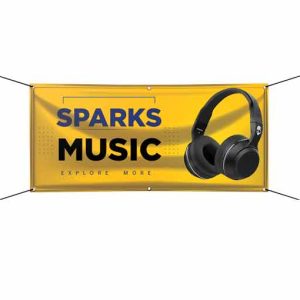
Outdoor banners in the Virgin Islands are a practical way to promote a grand opening, announce an event, identify a construction project or attract attention to a special offer. They are portable, relatively economical and available in sizes that can be seen from across a parking lot or roadway.
In the U.S. Virgin Islands, however, ordering a successful outdoor banner requires more than selecting its dimensions and uploading a logo.
Strong sunlight, frequent wind, salt air and tropical weather all affect how a banner should be designed, produced and installed. Before ordering, consider where it will hang, how long it will remain outdoors and how people will view it.
Start with the installation location
The most important question is not simply, “What size banner do I need?” It is, “Where and how will it be displayed?”
A banner attached flat against a solid wall behaves differently from one stretched across an open fence. A banner installed under a covered gallery receives less direct sun and rain than one facing the road. A temporary event banner does not necessarily need the same material or finishing as one intended to remain outdoors for months.
Before production, identify:
- The available installation area
- Whether the location is sheltered or exposed
- The expected viewing distance
- Whether people will see it while walking or driving
- The intended display period
- How the banner will be attached and removed
Photographs and measurements of the installation area can help your printer recommend an appropriate size, material and finishing method.
Vinyl or mesh?
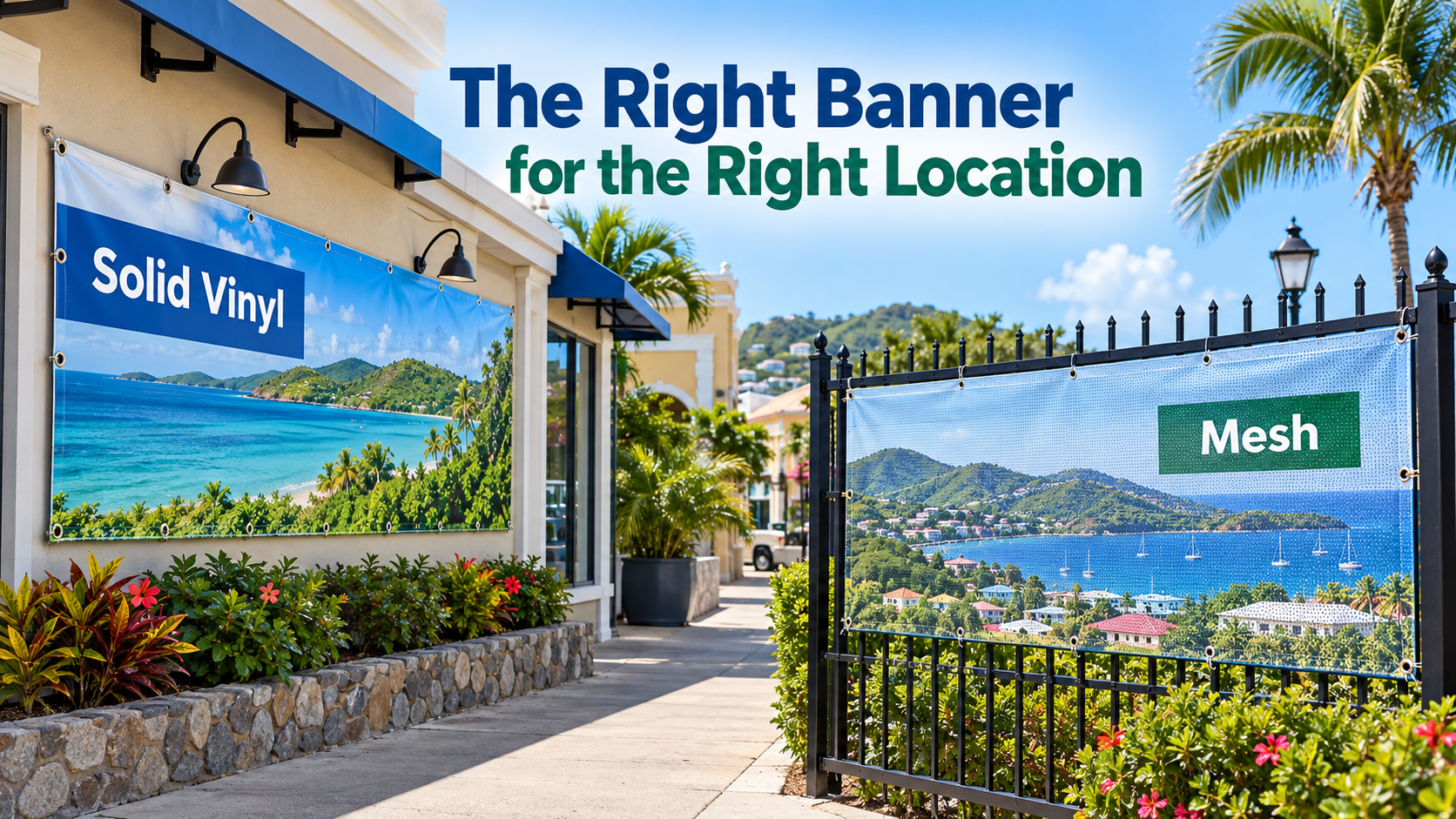
Standard banner vinyl provides a solid printing surface, producing strong color and excellent image coverage. It is commonly used for storefronts, events, sales promotions and general business advertising.
Mesh banner material contains small openings that allow some air to pass through. Manufacturers position mesh products for exposed applications such as fences, construction barricades and building graphics. The openings reduce the solid surface presented to the wind, although they also make the printed image somewhat less dense than it would appear on solid vinyl.
Mesh may be worth considering when a banner will be installed on an open fence or in another consistently breezy location. Solid vinyl may offer the better appearance when color richness, opacity or close-up viewing is more important.
Neither material makes a banner hurricane-proof. Material selection, banner size, installation method and the strength of the supporting structure all affect performance.
Finishing is part of the product
A banner is only as dependable as the way its edges and attachment points are prepared.
Hems reinforce the perimeter by folding and securing the edge. Grommets create attachment points for rope, cords, hooks or other hardware. Pole pockets may be appropriate when the banner needs to slide over a pole or support bar.
The number and placement of attachment points should reflect the banner’s size and installation. Using only the four corner grommets on a long banner can concentrate stress in a few small areas. Distributing the load more evenly may help the banner remain flatter and reduce strain on individual attachment points.
Do not assume that every wall, fence or railing is suitable. The property owner or installer should verify that both the mounting hardware and supporting structure can safely handle the banner and expected conditions.
Design for the way people will actually see it
A banner is not an oversized flyer. Viewers usually have only a few seconds to understand it.
An effective outdoor banner normally needs:
- One clear primary message
- Large, readable lettering
- Strong contrast between the words and background
- Limited supporting information
- A simple call to action
- A logo that remains recognizable from the expected distance
A phone number or website can be useful, but only if it is large enough to read. Long paragraphs, multiple competing headlines and collections of small logos may look acceptable on a computer screen yet become visual clutter at full size.
For roadside use, concentrate on the business name, main message and one next step. A person driving past cannot safely study detailed copy.
Supply artwork at the correct proportions
Banner artwork should be created in the same width-to-height proportion as the finished product. A design prepared as a square social-media post cannot be stretched into a wide banner without distortion.
Photographs must also contain enough detail for the final size. Large-format graphics can often use a lower effective pixel density than brochures or business cards because they are viewed from farther away. However, the proper resolution depends on the banner dimensions, image content, production process and viewing distance—not on one universal number. HP’s large-format guidance likewise recommends matching resolution to viewing distance and confirming color and file requirements with the print provider.
Logos and lettering are usually best supplied as vector artwork when available. A proper PDF may preserve vector shapes, fonts and page dimensions, while merely saving a small JPEG as a PDF will not improve its quality.
Plan for sun, wind and weather
No outdoor banner remains new indefinitely. Ultraviolet exposure can fade printed color over time, while movement, abrasion, moisture and wind loading can wear the material and attachment points.
Inspect an installed banner periodically. Look for loose hardware, stretched grommets, torn edges, fraying cords or movement that could damage the supporting structure. A banner that has begun to fail should be removed rather than left until it separates completely.
Most importantly, take temporary banners down well before severe weather arrives. NOAA advises securing loose outdoor objects when a storm threatens, and the National Hurricane Center specifically warns that signs and other outdoor materials can become dangerous windborne debris during hurricanes.
A mesh banner may reduce everyday wind pressure, but it should never be treated as permission to leave a temporary installation in place during a tropical storm or hurricane.
A better banner begins before it is printed
Two banners with the same dimensions can require very different specifications. The best choice depends on the location, exposure, duration, artwork and installation—not simply the lowest available price.
Caribbean Printing & Marketing can help evaluate those details before production. Tell us where the banner will hang, how it will be viewed and how long you expect to use it. We can then help you choose an appropriate material, size and finishing method, inspect the artwork and coordinate production and delivery.
Planning an outdoor banner for your business, property or event? Contact CPM with your dimensions and a photograph of the installation area, and we will help you determine the best way forward.
Sources
HP: Large-format printing and resolution guidance
NOAA: Hurricane preparedness guidance
National Hurricane Center: Hurricane readiness and outdoor hazards