A sign can look excellent on delivery and still be the wrong sign for the job. The material underneath the printing affects how rigid the panel feels, how it mounts, how it responds to weather and how much sense it makes to invest in it.
That decision matters in the U.S. Virgin Islands. Strong sunlight, heat, salt air, sudden rain and wind can be demanding, especially when a sign remains exposed all day. The best choice is not automatically the most expensive material. It is the material that matches the sign’s purpose, placement and expected service life.
Here is a practical way to compare three common rigid-sign options.
Corrugated Plastic: Economical and Best for Short-Term Use
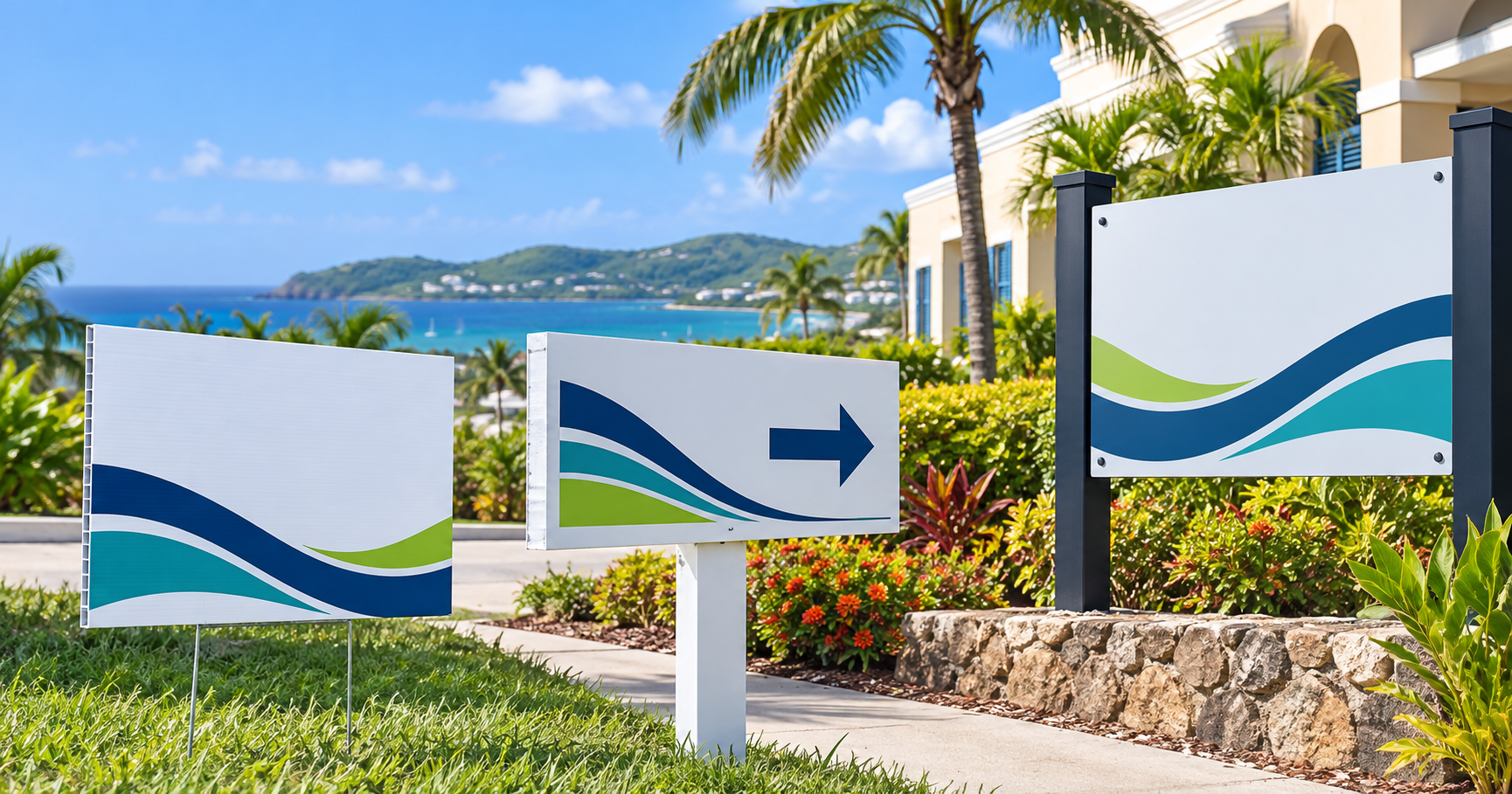
Corrugated plastic—often called Coroplast, after a widely recognized brand—is a lightweight, fluted polypropylene sheet. Its hollow channels make it easy to carry, economical to print and compatible with wire stakes.
It is a sensible choice for:
- Temporary event and directional signs
- Political and campaign signs
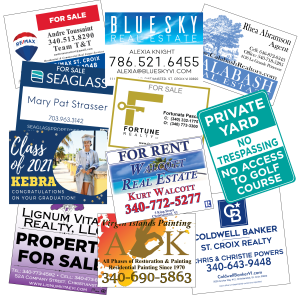
- Short-term real estate or open-house signs
- Construction notices
- Promotions that will change soon
Its great advantage is affordability. If you need multiple signs for a weekend event or a campaign with a defined end date, paying for a long-term substrate may add cost without adding value.
The tradeoff is durability. Corrugated plastic can bend, crease or pull away from its supports, and prolonged sun exposure can fade printed graphics. Wind loading also increases with the size of the panel. It should be treated as a temporary sign material, not as a permanent property sign simply because it can be placed outdoors.
Expanded PVC: Smooth, Rigid and Versatile
Expanded PVC is a solid, lightweight plastic sheet with a smooth surface. It produces crisp printed graphics and feels more substantial than corrugated plastic. It is commonly used for indoor signs, menu boards, displays, directional signs and presentation panels.
PVC is a strong option when you want:
- A polished, smooth appearance
- More rigidity than corrugated plastic
- A sign that can be cut into custom shapes
- Indoor or protected-outdoor placement
- A choice of thicknesses for different applications
Thickness matters. A thin PVC panel suitable for an indoor wall may flex too much for an exposed outdoor installation. The manufacturer of SINTRA expanded PVC recommends thicker gauges for exterior use, illustrating why “PVC” alone is not a complete specification.
PVC also needs appropriate support. A larger panel attached at only a few points may flex or warp, particularly when exposed to heat. For sheltered entrances, interior wayfinding and short-to-medium-term displays, however, it can provide an excellent balance of appearance, weight and cost.
Aluminum Composite: A Better Fit for Longer-Term Outdoor Signs
Aluminum composite material, commonly shortened to ACM, consists of thin aluminum faces bonded to a plastic core. This construction creates a flat, rigid panel without the weight of solid aluminum.
ACM is often the better choice for:
- Building and property identification
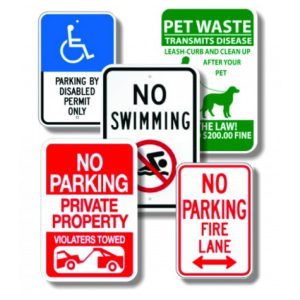
- Parking, policy and regulatory signs
- Long-term real estate or development signs
- Exterior directional signs
- Post-, fence- or wall-mounted business signage
Manufacturers describe ACM panels such as DIBOND as suitable for outdoor applications, with a smooth surface for direct printing. Compared with corrugated plastic, ACM resists bending and presents a more permanent, professional appearance.
That does not make every ACM sign indestructible. Printed inks, mounting hardware and installation method still influence performance. Edges and fastener locations must be considered, and a large panel in an exposed location may require an installer to determine the proper structure and wind resistance.
Match the Material to the Real Job
Before ordering, answer these questions:
- Will the sign be indoors, sheltered or fully exposed? A covered lobby sign and a roadside sign face very different conditions.
- How long should it remain in service? Days, months and years point toward different materials and budgets.
- How large will it be? Larger panels catch more wind and may need greater thickness, more support or a different substrate.
- How will it be mounted? Wire stakes, screws, posts, frames and adhesive mounting each impose different requirements.
- How close will people view it? Smooth PVC or ACM may be preferable when finish quality and edge appearance are important.
- Will the information change? A temporary panel may be smarter for dates, prices, tenants or event details that will soon be outdated.
The Printed Surface Matters Too
Substrate selection is only part of the decision. Direct printing, printed vinyl, lamination and protective films can produce different results. A protective layer may help with abrasion or cleaning, but it cannot turn a temporary substrate into a permanent one.
Color expectations also deserve attention. Constant tropical sun is demanding on printed graphics, and no responsible printer should promise that every color will remain unchanged indefinitely. Placement often matters as much as material: the same sign may age differently on a shaded wall than in unobstructed afternoon sun.
Why a Printer Should Review the Application
A useful sign quote should cover more than size and quantity. CPM’s concierge-style guidance begins with how and where the sign will be used. We can help compare material, thickness, printed sides, finishing and mounting considerations before production—when changes are easiest and least expensive.
That review can also prevent two common mistakes: overspending on a temporary sign and underspending on a sign expected to represent a business for years.
If you are planning new property, directional, event or business signage in the Virgin Islands, request a quote from Caribbean Printing & Marketing and describe the location, size, mounting method and intended service life. Photos of the installation area are helpful. We will recommend an option that fits the actual application rather than simply defaulting to one material.